One-Sentence Positioning + 3 Proof Points
Write a clear one-sentence positioning statement and 3 proof points so the right customers self-qualify faster (and the wrong ones bounce).
📌 Summary
Outcome: Clear messaging that attracts the right customers and repels the wrong ones.
Time: 45 minutes setup, then 10 minutes/month to refine.
Owner: Founder / GTM owner.
Steps: Pick a primary customer → write one sentence → add 3 proof points → sanity-check → deploy everywhere.
Metrics: Better-fit inbound, higher conversion on your homepage, faster “fit / no fit” clarity.
Glossary:
ICP = Ideal Customer Profile
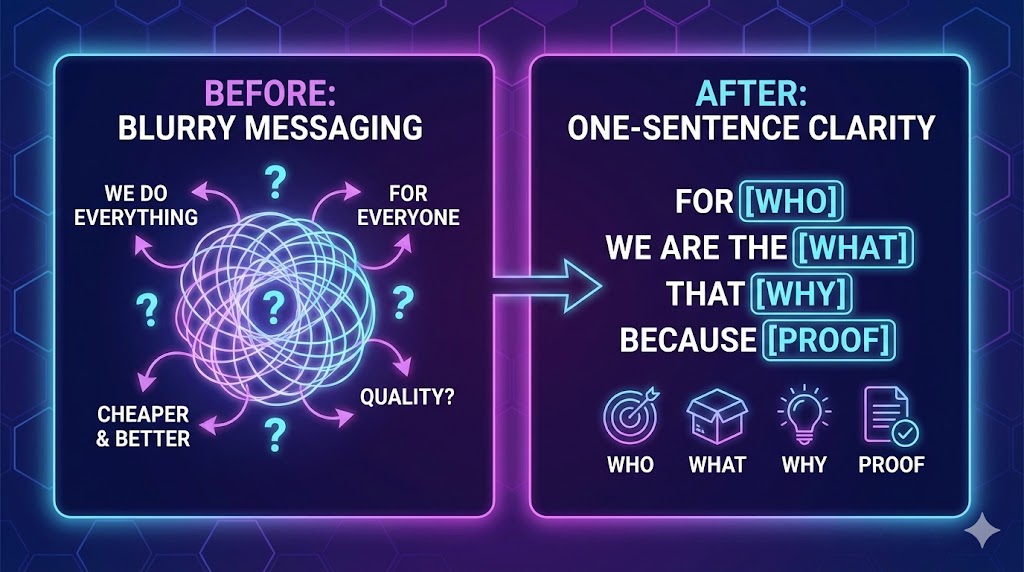
🎯 What you’ll achieve (in 2 weeks)
You’ll explain what you do in one sentence without jargon.
Your website, sales, and marketing will feel consistent.
People will self-qualify faster (“this is for me / not for me”).
⏱️ Time & effort
Setup: 45 minutes
Ongoing: 10 minutes/month
Owner: Founder / GTM owner
Dependencies: None
🚦 When to use this (signals)
Use this quick win if:
People ask “So what do you do?” and you answer differently every time.
Your website reads like a feature list.
Different teammates pitch different stories.
You attract interest, but the leads are low quality.
⭐️ The output (what you’re building)
One positioning sentence (who + outcome + how)
Three proof points (specific reasons to believe)
That’s it. No manifesto.
🧩 Step-by-step (follow in order)
Step 1) Pick a primary customer (in one line)
Don’t try to be for everyone. Choose one main “who” first.
Examples (not tied to any product category):
Fintech (lending): “SMEs in US with $50k–$500k annual revenue applying for working-capital credit.”
Consultancy: “Operations teams in 20–200 person companies that need process redesign and ongoing support.”
Ecommerce brand: “DTC brands doing $300k–$3M annual sales struggling with repeat purchases and support volume.”
B2B SaaS: “Founder-led B2B teams selling to 10–200 employee companies with long sales cycles.”
Local service business: “Multi-location clinics that manage bookings, follow-ups, and payments across staff.”
If you serve multiple, pick the one closest to revenue today.
Step 2) Write your one-sentence positioning
Use this structure:
For [WHO], [PRODUCT/SERVICE] helps you [ACHIEVE OUTCOME] by [HOW IT WORKS / DIFFERENTIATOR].
Examples (generic, reusable):
Fintech (lending): “For SMEs that need working capital fast, we provide credit decisions in hours by underwriting from real-time business data.”
Consultancy: “For growing companies, we help you improve operational performance by diagnosing bottlenecks and implementing simple, measurable routines.”
Ecommerce brand: “For shoppers who want clean skincare, we deliver dermatologist-tested products by combining transparent ingredients with fast fulfillment.”
B2B SaaS: “For customer support teams, our software reduces resolution time by automating triage and surfacing the right answers instantly.”
Local service business: “For busy families, our clinic makes care easy by offering same-week appointments and proactive follow-ups.”
Keep it plain. No buzzwords. Outcome first.
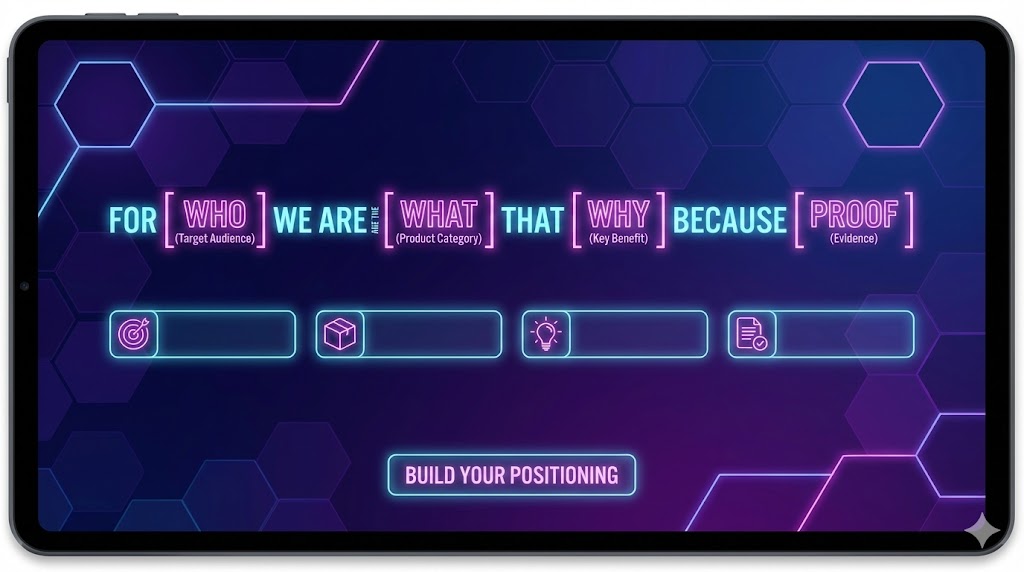
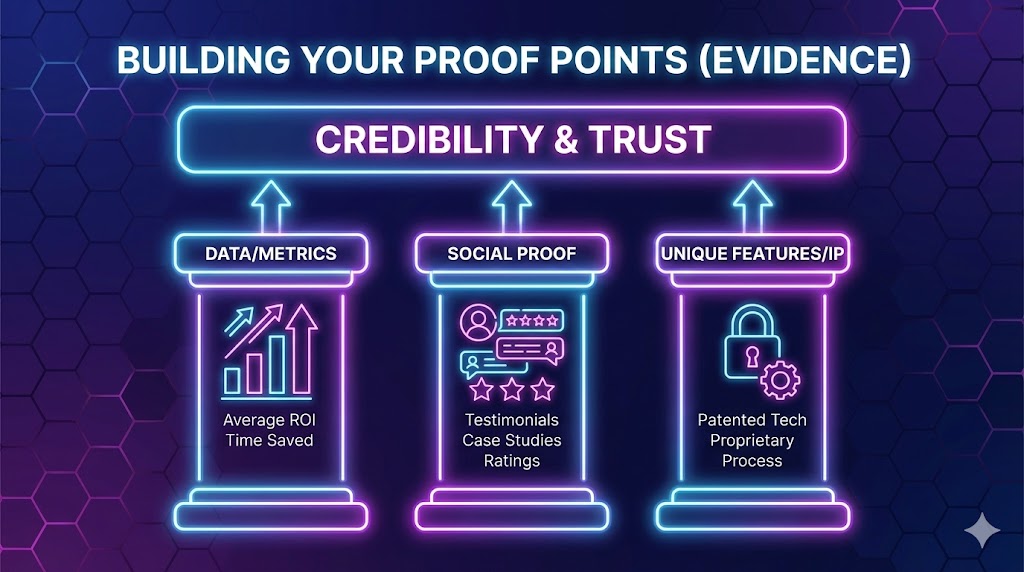
Step 3) Add 3 proof points (reasons to believe)
Pick 3 different types so they reinforce each other. Your proof points should be specific (avoid “fast, easy, modern”).
A) Outcome proof (what improves): A concrete result customers get:
“Decisions in <24 hours instead of 7–14 days.”
“Cut onboarding time from 2 weeks to 2 days.”
“Reduce support backlog by 30% within 60 days.”
“Increase repeat purchase rate by +X%.”
“Improve on-time delivery from X% to Y%.”
B) Mechanism proof (how it works): The specific method or system that produces the outcome:
“We use a 3-step workflow: diagnose → implement → weekly review.”
“We underwrite based on bank transactions + invoicing history, not just credit bureau.”
“We standardize intake data and enforce ownership at each handoff.”
“We use a fixed deliverable cadence (weekly milestones + acceptance criteria).”
“We integrate the top 3 tools you already use so data doesn’t get re-entered.”
C) Trust proof (why you’re credible)
Why someone should believe you (even if you’re early):
“We’ve done this with teams like [industry/segment] and know the common failure modes.”
“Team has [relevant prior experience] (ex: credit risk, ops leadership, clinical ops).”
“We publish our methodology and benchmarks (transparent process).”
“References available from 2–3 customers in your segment.”
“Compliance / standards (only if true): PCI, SOC2 roadmap, regulated partner, etc.”
If you don’t have logos/case studies yet:
Use Mechanism proof + Trust proof based on credible specifics: your method, your constraints, your experience, early referenceability, and the failure modes you’re designed to handle.
Step 4) Run a 3-question sanity check
Ask:
Is the “who” specific enough? (If it fits everyone, it fits no one.)
Does it promise an outcome (not a feature list)?
Would a customer instantly know if this is for them?
If any answer is “no,” tighten.
Step 5) Deploy it in 5 places (same wording)
Use your one sentence + 3 proof points in:
Website hero + sub-hero
About page / product page
First lines of outreach (email/DM)
Your first 2 minutes on calls
Your internal “what we do” doc
Consistency compounds.
✅ Done Definition (DoD)
You’re “done” when:
You have 1 positioning sentence everyone uses
You have 3 proof points that are concrete (not vague adjectives)
The sentence appears on your website and in outreach
You can say it out loud in under 10 seconds
⚠️ Common mistakes (avoid these)
Mistake: “All-in-one for everything” → Do this instead: lead with one primary outcome for one primary customer.
Mistake: Stuffing features into the sentence → Do this instead: outcome first, mechanism second.
Mistake: Proof points that are adjectives (“easy, modern, powerful”) → Do this instead: specifics (workflow, routine, failure mode).
Mistake: Rewriting weekly → Do this instead: keep stable for a month, measure, then iterate.
📈 How to know it’s working (in 2 weeks)
People stop asking “what is this?” and start asking “can it help with X?”
Better-fit inbound (fewer random leads)
Faster fit/no-fit clarity in the first conversation
Improved conversion on your homepage or “contact” CTA
❓ FAQ
What if we have multiple products or modules?
Pick one “front door” outcome. Modules can appear later—after the customer understands the value.
Should we mention our category (CRM, ERP, OS, etc.)?
Only if it helps comprehension. If labels confuse your audience, lead with the job-to-be-done instead.
What if we don’t have strong proof yet (no case studies)?
Use mechanism proof + real-world insight: explain the specific failure modes you designed for, and the concrete workflow that prevents them.
🔗 Related quick wins
Want this to run automatically?
You can do positioning with a doc and deploy it manually. If you’re using Super, you can keep your target customer, messaging, and workflows connected—so your positioning is reflected in what you capture, how work gets routed, and what you measure end-to-end.