Centralize Lead Capture + Make “Lead Source” Mandatory
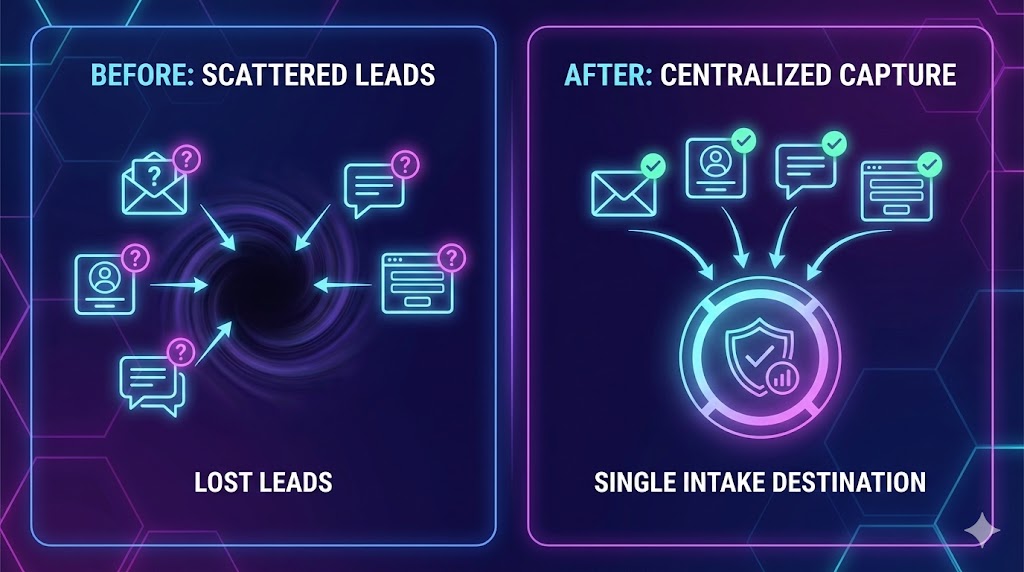
Centralize every inbound lead into one intake destination and make “lead source” mandatory so you stop losing leads and learn what channels work.
📌 Summary
Outcome: No leads slip through cracks + you know what channels drive meetings and revenue.
Time: 45–60 minutes setup, then 5 minutes/day (manual) or 0–2 minutes/day (automated).
Owner: Sales lead (or Founder) + whoever manages inbound channels.
Steps: Pick a path → map channels → standardize fields → enforce lead source → run daily sweep + weekly review.
Metrics: % leads with source, lost leads/week, meetings/bookings by source.
🎯 What you’ll achieve (in 2 weeks)
Every lead lands in one place (no lost emails, DMs, or “someone told me”).
Lead source becomes visible so you can stop guessing where to invest time/money.
Cleaner follow-up because intake is consistent and ownership is clear.
⏱️ Time & effort
Setup: 45–60 minutes
Ongoing:
Manual: 5 minutes/day “capture sweep”
Automated: 0–2 minutes/day “exceptions sweep”
Owner: Sales lead (or Founder)
Dependencies: One intake destination + a simple lead record
🚦 When to use this (signals)
Use this quick win if:
Leads come from many places (site forms, email, WhatsApp, social DMs, referrals) and get missed.
You can’t answer: “Where did our last 10 customers come from?”
Handoffs are messy (“I thought you replied”).
You don’t have a reliable “new leads” queue.
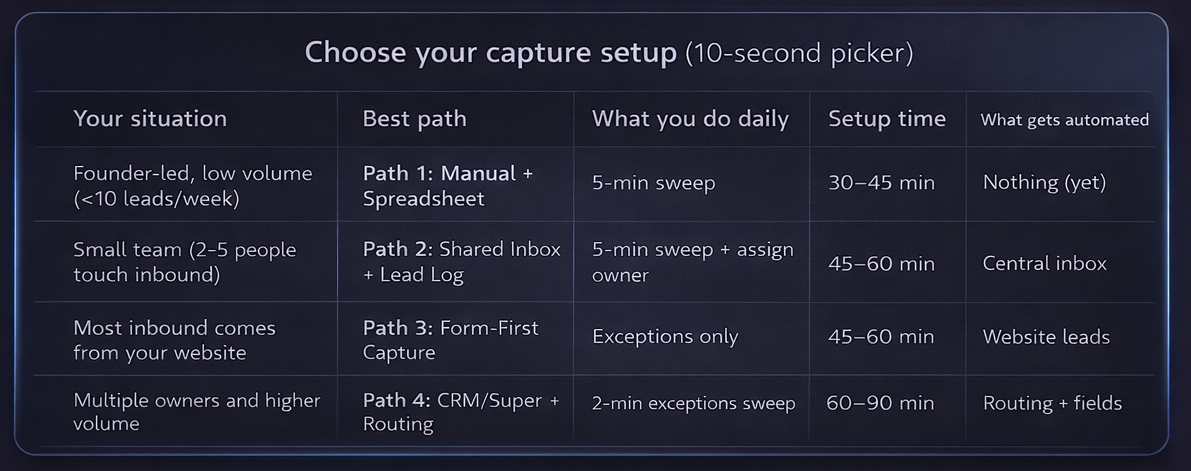
Choose your capture setup (10-second picker)
🧩 Step-by-step (follow in order)
Step 1) Choose your intake destination (one place where new leads live)
Pick one place that becomes the source of truth for new leads:
Super
A CRM “New Leads” list
A shared inbox + a lead log sheet
A form that writes into a table/sheet
A simple spreadsheet
You’re not picking the “perfect tool.” You’re picking one place everyone agrees is the truth.
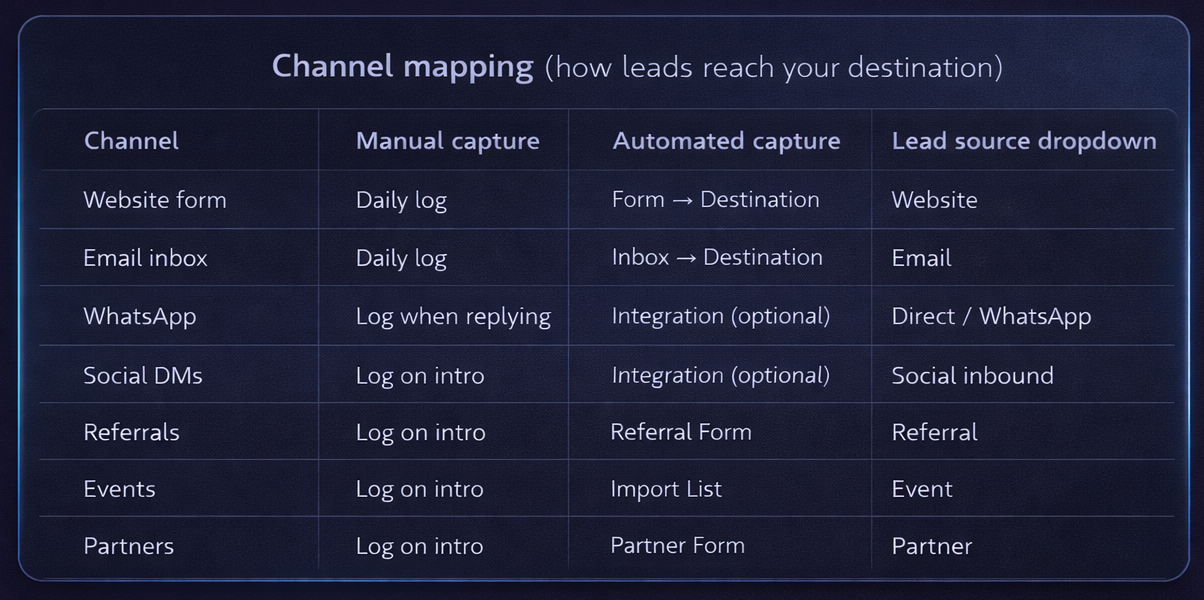
Step 2) Map channels → destination (manual or automated)
Use this table to decide how leads reach your destination:
Step 3) Standardize the minimum viable lead record (don’t overdo it)
Required
Name
Company
Email or phone
Lead source (dropdown)
Date received
Owner
Optional
Role/title
Notes
Status (New / Contacted / Qualified / Disqualified)
Step 4) Make “Lead Source” mandatory (dropdown, not free text)
Keep it short: 8–12 options max.
Suggested dropdown:
Website (organic)
Website (paid)
Referral
Partner
Social (inbound)
Outbound (reply)
Event
Existing customer / upsell
Other (with note)
Step 5) Set simple routing rules (ownership)
Choose one:
Single owner for all inbound (easiest early stage)
Round robin
Route by segment (industry / country / size)
Goal: speed + accountability, not perfect assignment.
Step 6) Run the daily sweep (manual) or exceptions sweep (automated)
Manual daily sweep (5 minutes/day)
Check channels
Capture any new leads into the destination
Assign owner
Select lead source
Automated exceptions sweep (0–2 minutes/day)
Check “missing owner/source” leads
Fix the few exceptions
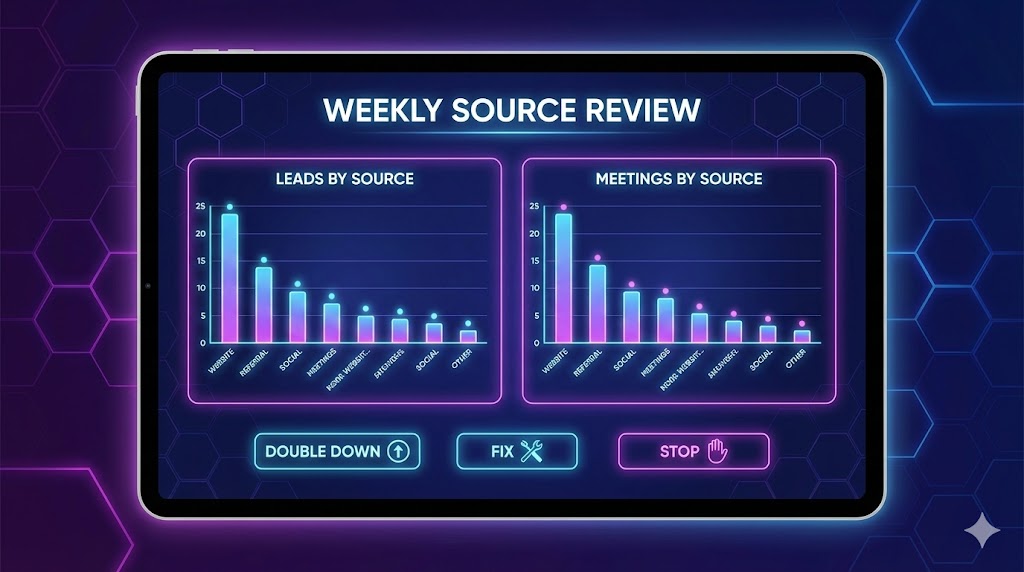
Step 7) Review weekly: what sources create meetings?
In 10 minutes:
Leads by source
Meetings/bookings by source
Pick one action: double down, fix, or stop
You don’t need perfect attribution—just directional truth.
✅ Done Definition (DoD)
You’re “done” when:
All inbound channels feed a single intake destination (manual or automated)
Every new lead has an owner within 24 hours
Lead source is a required dropdown field
A daily sweep exists (manual or exceptions)
A weekly 10-minute source review is scheduled
⚠️ Common mistakes (avoid these)
Mistake: Tracking 30 lead sources → Do this instead: 8–12 dropdown options max.
Mistake: “Other” becomes 50% → Do this instead: review “Other” monthly and promote common items into the dropdown.
Mistake: Leads live only in DMs → Do this instead: log them the moment you reply.
Mistake: No owner assigned → Do this instead: assign owner at capture, not later.
📈 How to know it’s working (in 2 weeks)
Process metric: ≥95% of new leads have a lead source selected
Coverage metric: 0–1 “lost” leads/week (leads that contacted you but never got a response)
Outcome proxy: you can name your top 2 sources by meetings booked
❓FAQ
What if we have multiple products or funnels?
Still use one intake destination. Add one extra field: “Product interest” (dropdown).
What if we can’t tell paid vs organic website leads?
Start with “Website” as one source. Split later once tracking improves.
Does this matter if inbound volume is low?
Yes—low volume means every lead matters more, and source learning compounds over time.
🔗 Related quick wins
Follow-Up SLA: Respond to New Leads Within a Set Time (and Track It)
Define Your Sales Pipeline Stages (with Clear Entry/Exit Criteria)
Want this to run automatically?
You can implement this with any tools. If you’re using Super, you can centralize lead capture, require lead source, and route new leads to the right owner in one place.