Standard Payment Terms + A Weekly Collections Routine
Standardize payment terms and run a weekly collections routine to improve cash flow and reduce overdue invoices without chaos.
📌 Summary
Outcome: Faster cash collection, fewer surprises, less awkward chasing.
Time: 45–60 minutes setup, then 20 minutes/week.
Owner: Finance/Admin owner (or Founder) + Sales for escalations.
Steps: Standardize terms → invoice immediately → set a weekly AR review → follow a simple reminder ladder → escalate consistently.
Metrics: Days Sales Outstanding (DSO), % invoices paid on time, overdue balance.
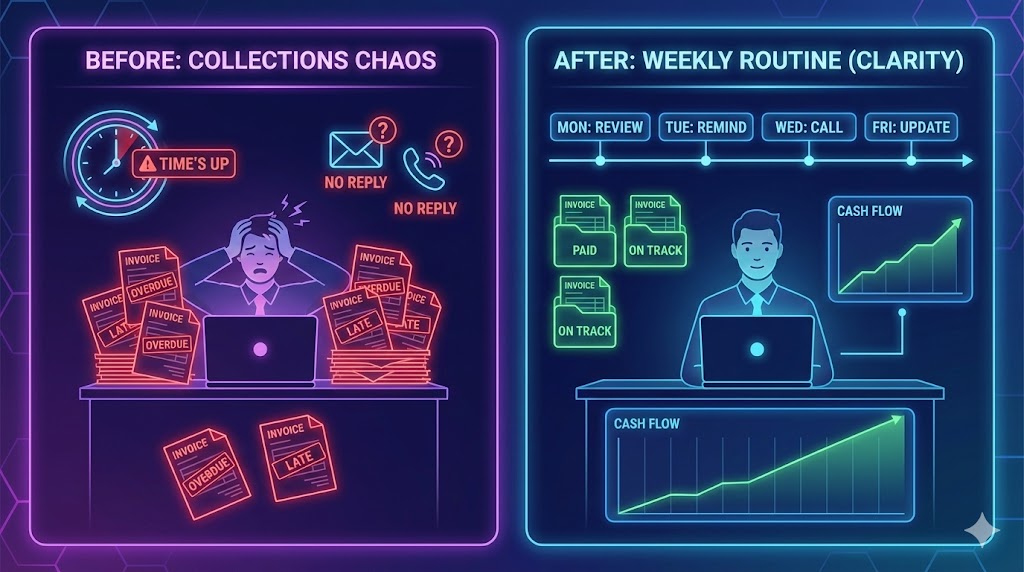
🎯 What you’ll achieve (in 2 weeks)
Customers know what to expect (terms stop being negotiated deal-by-deal).
You get paid faster because invoicing and follow-ups are consistent.
Overdue invoices stop “hiding” until they become a crisis.
⏱️ Time & effort
Setup: 45–60 minutes
Ongoing: 20 minutes/week (more if you have many invoices)
Owner: Finance/Admin owner (or Founder)
Dependencies: A way to send invoices and track paid/unpaid (Super, accounting tool, or spreadsheet)
🚦 When to use this (signals)
Use this quick win if:
Invoicing timing depends on memory (“we’ll send it later”).
Payment terms vary widely and feel improvised.
You don’t have a weekly view of what’s overdue and by how much.
Cash flow surprises happen even when revenue looks “good.”
🧩 Step-by-step (follow in order)
Step 1) Choose your standard terms (pick 1 default + 1 exception)
Keep it simple. Examples:
Default: Net 7 / Net 14 (or pay upfront for smaller plans)
Exception: Net 30 only for specific customer types you explicitly choose
Rule: you can make exceptions, but they must be intentional and visible.
Step 2) Put terms in writing (every time)
Terms must appear in:
Proposal / order form (if you have one)
Invoice
Email confirmation (“Terms: Net 14 from invoice date”)
This avoids “I didn’t know” conversations later.
Step 3) Invoice immediately (define “immediately”)
Pick the rule your team can follow:
Subscriptions: invoice on contract signature (or automatically on the billing date)
Services / one-offs: invoice the same day delivery is confirmed
Milestones: invoice within 24 hours of milestone acceptance
The biggest collection issue is often late invoicing, not late paying.
Step 4) Create a simple Accounts Receivable (AR) view
You only need these columns:
Customer
Invoice #
Amount
Invoice date
Due date
Status (Open / Paid / Disputed)
Days overdue
Owner (who follows up)
Notes (last touch)
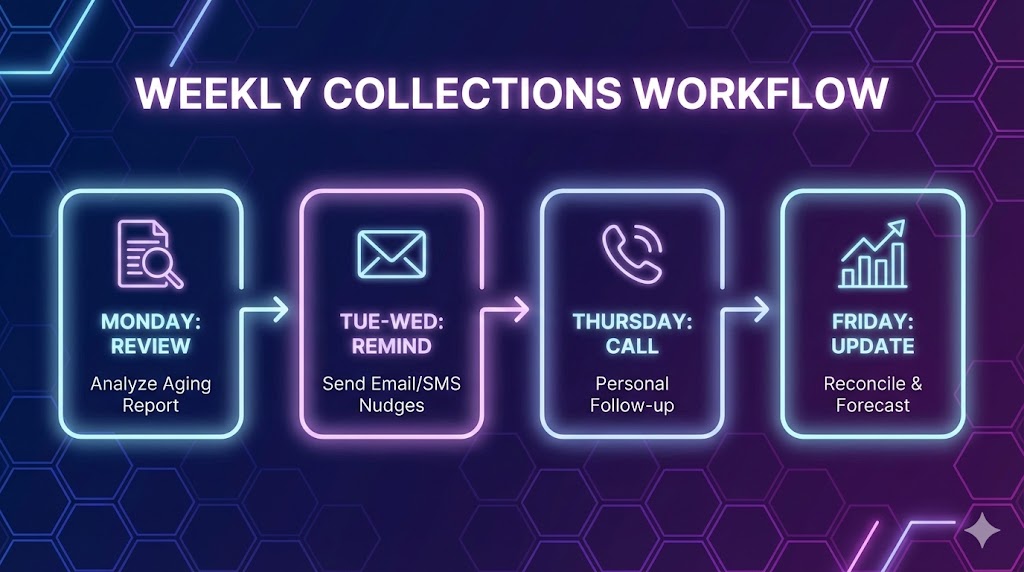
Step 5) Run a weekly collections routine (20 minutes)
Same day every week (e.g., Monday 9:30am):
Sort by days overdue
Identify the top 10 overdue by amount or risk
Send reminders (see ladder below)
Mark next action + date
Flag anything needing Sales/Founder escalation
Consistency beats intensity.
Step 6) Use a reminder ladder (polite, predictable)
Keep it boring and professional:
3 days before due: friendly reminder + invoice attached
On due date: “Just a heads up—due today”
7 days overdue: firmer reminder + ask for payment date
14 days overdue: escalate to decision-maker + pause/hold policy if applicable
21+ days overdue: final notice + stop service (if contract allows) or formal collection steps
You’re not “being mean.” You’re running a system.
Step 7) Decide your escalation and pause policy (only if needed)
Define one clear rule:
When do you involve Sales/Founder? (e.g., >€X or >14 days overdue)
When do you pause service? (e.g., >21 days overdue and no plan)
When do you write off? (rare early stage, but define who decides)
✅ Done Definition (DoD)
You’re “done” when:
You have a default payment term + one exception rule
Terms appear in proposals and invoices
Invoices go out immediately based on a defined rule
You have one AR view with due date + status + owner
A weekly collections review is scheduled and run
A reminder ladder + escalation rule exists
⚠️ Common mistakes (avoid these)
Mistake: Negotiating terms on every deal → Do this instead: one default, one exception.
Mistake: Invoicing late → Do this instead: invoice within 24 hours of the trigger event.
Mistake: Reminders depend on mood → Do this instead: weekly routine + ladder.
Mistake: Sales promises “we’ll figure it out later” → Do this instead: require terms before “Won.”
📈 How to know it’s working (in 2 weeks)
Process metric: 100% of invoices have clear due dates and owners
Speed metric: fewer invoices become 14+ days overdue
Outcome proxy: overdue balance decreases week over week (even if slowly)

❓ FAQ
What if customers demand Net 30 (or Net 60)?
Decide in advance who qualifies for exceptions. If you accept Net 30, balance it with a higher price, partial upfront, or annual prepay options.
What if we’re subscription-based—should we do prepaid?
If you can, yes. Annual upfront (with a discount) is often the cleanest cash-flow improvement.
What if an invoice is “disputed”?
Mark it as Disputed, assign an owner, and set a due date for resolution. Disputes should not sit in the same bucket as “Open.”
Should Sales be involved in collections?
Only on escalations. Make Finance/Admin the default owner; involve Sales when relationship or negotiation is required.
🔗 Related quick wins
Define Your Sales Pipeline Stages (with Clear Entry/Exit Criteria)
Commitments List: Know What You’ve Promised Before Cash Moves
Want this to run automatically?
You can implement this with any tools. If you’re using Super, you can standardize payment terms, automate invoicing triggers, and run a weekly collections view with reminders in one place.